Note / 2026
THE WORLD AS PERFORMER
Building Quinta do Pinto through scenography, material and impossible physics
I studied scenography through set and costume design, so when I begin making an image I rarely think first about the image itself.
I think about the world.
What is it made from?
How does it behave?
What are its physical rules?
How does scale operate?
What happens within it that tells us something without needing to be explained?
This way of thinking became central to the development of Quinta do Pinto.
The film approaches moving image as scenography: constructing a synthetic world in which material, architecture, scale and movement become the storytellers.
It is not really a film about a bottle of wine.
It is a film about a world coming into existence.
STARTING WITH A MATERIAL
The starting point was extraordinarily simple:
Portuguese wine. Portuguese azulejos.
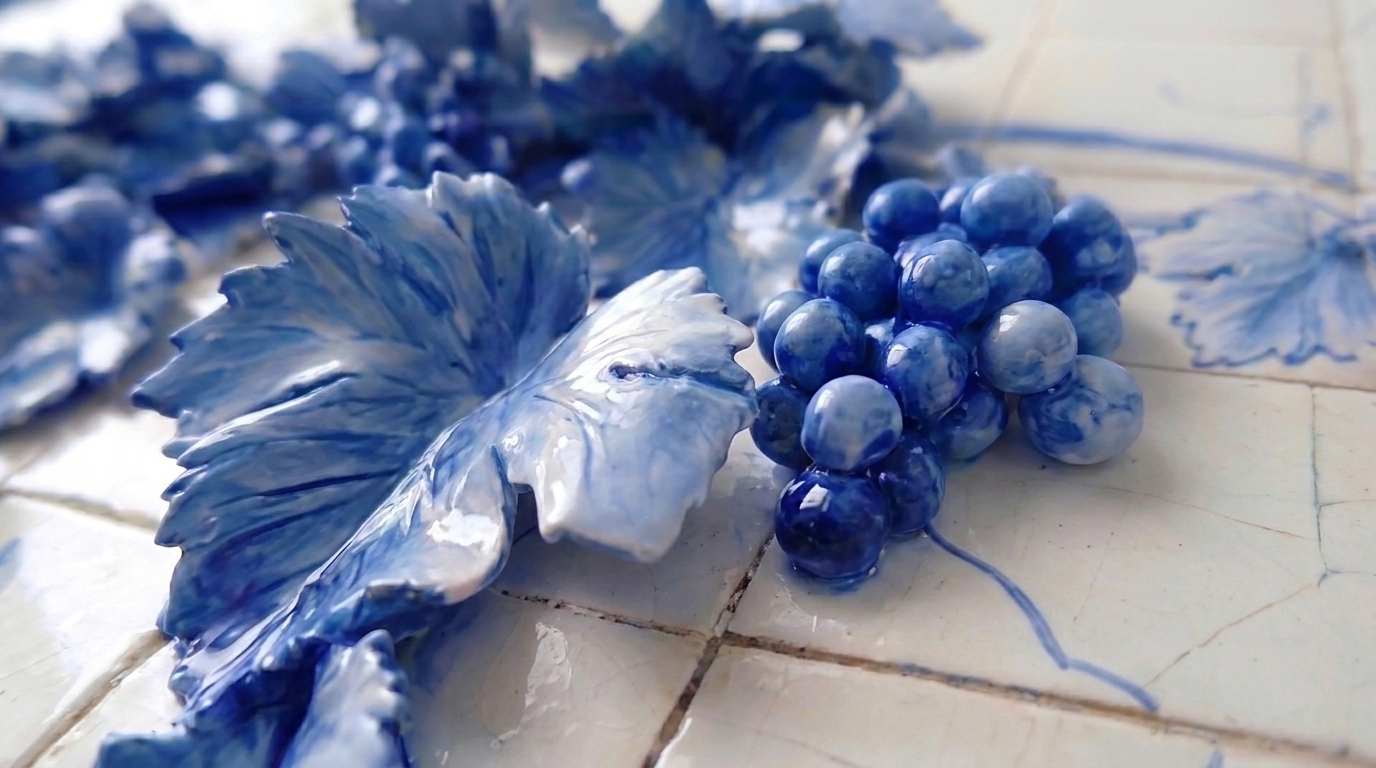
Rather than treating the tile as a decorative surface behind the product, I wanted the ceramic itself to become the world of the film.
That distinction was important.
There is no conventional room containing an azulejo wall.
There is no vineyard beyond it.
There is no distinction between landscape, illustration, architecture and object.
Everything belongs to the same material system.
Ceramic becomes leaf.
Ceramic becomes vine.
Ceramic becomes fruit.
Ceramic becomes landscape.
Eventually, ceramic becomes the architecture surrounding the bottle.
The material doesn’t decorate the world.
The material is the world.
That is a fundamentally scenographic decision.
ESTABLISHING THE RULES
When designing a physical set, you establish rules whether you realise it or not.
The architecture has dimensions. Materials have properties. Objects exist at particular scales. Light comes from somewhere. Gravity applies.
For Quinta do Pinto, I approached the generated environment in much the same way.
The difference was that I was able to invent the physics.
The world begins with a single cobalt drop against a pale ceramic surface.
At first we understand its scale.
It is tiny.
We are looking closely enough to see the glaze, grout, cracks and imperfections of the tile.
Then something begins to happen.
The cobalt does not simply spread across the surface like paint.
It begins to generate form.
A tendril becomes a stem.
A mark becomes a leaf.
The surface begins producing vegetation.
And gradually our understanding of scale starts to shift.
We are no longer looking at the tile.
We are moving inside it.
SCALE AS STORYTELLING
Scale is one of the most powerful tools available to a scenographer.
A small object can become monumental.
Architecture can make a body feel vulnerable.
Distance can create authority.
Compression can create anxiety.
In Quinta do Pinto, scale became the mechanism that allowed the world to transform.
The camera moves from the intimacy of a drop of cobalt into leaves that feel almost architectural.
Then the film opens further.
Rows emerge across an apparently endless ceramic plane.
The decorative language of an azulejo becomes a physical vineyard.
Individual grapes become enormous sculptural objects.
And eventually we move far enough away to understand that these apparently separate spaces have always belonged to one larger composition.
That progression was not simply a camera decision.
It was the scenography of the film.
Macro becomes landscape.
Surface becomes space.
Decoration becomes architecture.
The world changes because our relationship to its scale changes.
THE ENVIRONMENT PERFORMS
This connects directly to something I have been exploring in my wider work:
What happens when the environment becomes the performer?
There are no actors in Quinta do Pinto.
There don’t need to be.
The performance is carried by material.
A vine grows.
A surface fractures.
A leaf unfolds.
Grapes accumulate.
The landscape extends.
The architecture assembles itself.
The camera responds to those events.
Something is continually acting upon the world and the world is continually responding.
This is what interests me about scenography for moving image.
The set is no longer something waiting for the action to arrive.
The set is the action.
IMPOSSIBLE PHYSICS
Generative filmmaking becomes particularly interesting to me when it stops trying to imitate conventional filmmaking.
I could have created images of a beautiful Portuguese vineyard.
I could have placed a wine bottle in that vineyard.
It may have produced a perfectly successful piece of advertising.
But we already know how to make that film.
What interested me was a question that could not be answered through conventional location photography:
What if the vineyard itself were made from azulejos?
Not illustrated onto them.
Made from them.
What if ceramic could grow organically?
What if pigment could become matter?
What if a two-dimensional decorative tradition could become a navigable three-dimensional landscape?
These are impossible physical propositions.
And that impossibility is not something the film attempts to disguise.
It is the idea.
This is where I think the creative potential of generative AI becomes much more interesting.
Its value is not simply that it can recreate things we previously photographed, built or animated through other means.
Its value is that it allows us to begin asking different questions.
Not:
How do I recreate reality?
But:
What reality does this idea require?
REAL MATERIAL. IMPOSSIBLE BEHAVIOUR.
I am particularly interested in the tension between credibility and impossibility.
If everything in an image behaves fantastically, very little feels extraordinary.
So the ceramic in the film needed weight.
Glaze needed thickness.
Cracks needed irregularity.
Grout needed depth.
Leaves still needed veins.
Grapes still needed volume.
Light needed to respond convincingly to surfaces.
The impossible event works because the material itself feels plausible.
This is something I think about as:
REAL WORLD → UNREAL EVENT → REAL CONSEQUENCE.
A ceramic vine should not exist.
But once it does, it should occupy space convincingly.
It should cast shadows.
It should have mass.
Its branches should weave around other objects.
Its fruit should possess weight.
The world accepts its own impossibility.
That is where the image becomes convincing.
THE PRODUCT ARRIVES LAST
One of the decisions I like most in the finished film is that the bottle does not dominate the beginning.
The world comes first.
The viewer is allowed to experience material, transformation and scale before fully understanding where the sequence is heading.
Only toward the end does the architecture open up around the bottle.
By that point, the bottle is no longer an object placed in front of a decorative background.
It belongs to the world we have just watched being created.
The vineyard surrounds it.
The ceramic frames it.
The material from which the world has grown becomes the stage on which the product finally appears.
For me, that is the difference between putting a product into an image and constructing a world around an idea.
SCENOGRAPHY FOR THE SCREEN
I don’t think of Quinta do Pinto primarily as an experiment in AI animation.
I think of it as a scenographic exploration.
The technology made the world possible, but the decisions that shaped it came from somewhere much older:
material.
space.
scale.
composition.
movement.
light.
transformation.
narrative.
The same questions I once applied to a stage are now being applied directly to the moving image.
The difference is that the stage no longer has fixed dimensions.
The materials no longer have to obey their material properties.
And the environment no longer has to remain still.
A scenographer can design a world and then ask that world to perform.
Quinta do Pinto began with a drop of cobalt on a ceramic tile.
From that single material rule, an entire landscape could grow.
The film approaches moving image as scenography: constructing a synthetic world in which material, architecture, scale and movement become the storytellers.
And for me, that is where generative filmmaking becomes genuinely exciting.
Not replacing the world we already know how to film.
Building the worlds we previously could only imagine.