Note / 2026
ORIGIN STORY
Building a world around a bird, a grenade and an idea
Origin Story began with an image that already existed: a starling standing on a grenade. The question was what had to happen for that image to become inevitable.
The bird and the grenade had been part of the HERE NOW GONE identity from the beginning. Together they made an unlikely pair: one alive, curious and capable of movement; the other manufactured, inert and loaded with potential.
As a graphic mark, the relationship worked.
But I became interested in what existed before the mark.
Where had the bird come from? Where had it found the grenade? Why would it approach it? And what kind of world could bring these two completely unrelated things together?
That became the beginning of Origin Story.
Starting with the final image
My background is in set and costume design, fine art and creative direction, so I tend to think about images spatially. I rarely begin with a camera shot in isolation. I think about the world around it: where we are, what happened before we arrived, what might exist beyond the frame, and what conditions need to be created for an image to make sense.
That is fundamentally a scenographic way of working.
In theatre, you can know where a story needs to arrive and then construct the physical and visual conditions that allow that moment to happen. Space isn’t decoration around the narrative. Space participates in the narrative.
I approached Origin Story in much the same way.
I already knew the final composition: the starling and the grenade.
Instead of simply animating that logo, I wanted to construct the world in which that image might genuinely occur.
The logo became the destination rather than the starting graphic.
Two characters
Once separated from the logo, the starling and grenade began behaving less like symbols and more like characters.
The starling is organic. It moves. It responds. It investigates. Most importantly, it can choose where it goes.
The grenade is almost its opposite. It is manufactured, heavy and motionless. It doesn’t pursue anything. It simply exists, carrying an extraordinary amount of unresolved potential.
That contrast gave us the narrative.
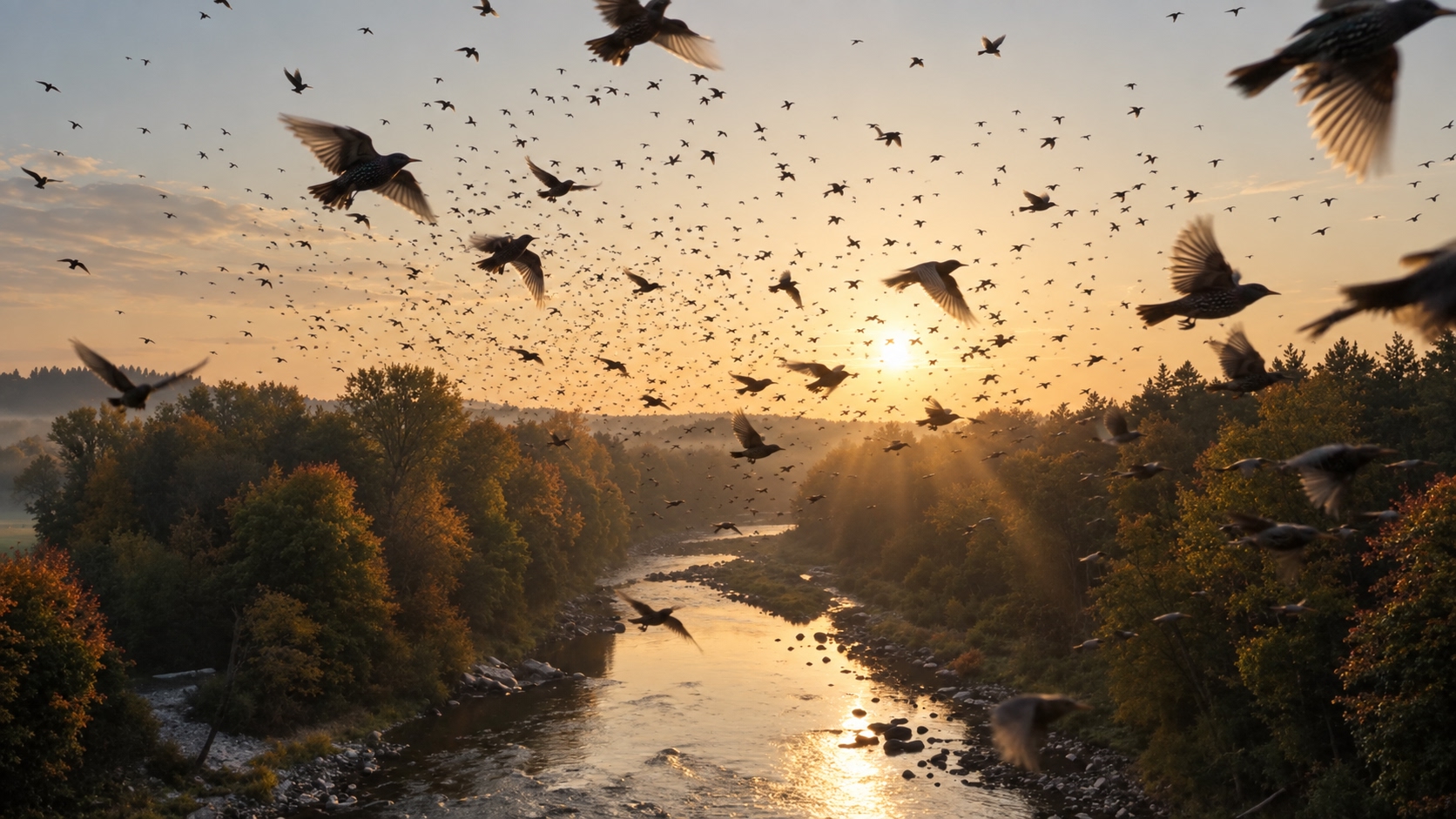
The film begins with thousands of starlings moving collectively above a river. One bird separates from the murmuration and travels downstream.
Below the surface, another collective exists: a school of tiny fish gathered around an object concealed beneath them. They scatter and reveal the grenade.
From there, the two trajectories gradually converge.
The bird explores.
The grenade waits.
Eventually the water recedes and something that belonged to the submerged world enters the bird’s world.
The starling notices it.
Then it gets closer.
Nothing explodes. Nothing needs to.
The potential is enough.
Borrowing a language we already understand
One of the most important decisions was to tell this strange story using an extremely familiar visual language: the natural-history documentary.
We know its grammar instinctively.
The enormous establishing landscape. The migration or collective behaviour. The isolated animal. The macro observation. The descent beneath the water. The school of fish. The patient narrator describing behaviour without judgement.
It’s a format associated with observation and truth.
That made it interesting territory for something entirely constructed.
Instead of inventing an overtly surreal visual language to tell a surreal story, I wanted to do almost the opposite. The more impossible the premise became, the more restrained and observational the filmmaking needed to feel.
The narrator never tells us what the grenade means.
Nature doesn’t suddenly become ominous when it appears.
There is no dramatic musical sting announcing danger.
The fish scatter. The current continues. The forest carries on.
The starling doesn’t know that it has entered a metaphor.
The audience does.
That gap became one of the most important parts of the film.
Scenography beyond the stage
Scenography is sometimes reduced to the design of scenery. I’ve never found that definition particularly useful.
For me, it is much closer to constructing the conditions through which a story can be experienced.
Space. Light. Material. Scale. Movement. Sound. Objects. Bodies. Their relationship to one another. And, crucially, what changes over time.
Origin Story uses all of those things.
The river isn’t simply a location. It creates two parallel worlds.
Above the surface there is air, warm light, forest and the murmuration.
Below it there is density, cooler light, suspended matter, fish and the grenade.
The waterline becomes a threshold between them.
As the film progresses, those worlds begin to collapse into one another. The grenade moves from water to exposed riverbed. The starling moves from sky to ground. Two objects that began in completely separate spatial systems eventually occupy the same few centimetres.
That’s scenography doing narrative work.
There doesn’t need to be dialogue explaining the convergence because the changing space tells us what is happening.
Making the impossible believable
AI made it possible to build camera movements and animal choreography that would be extraordinarily difficult — and in some cases effectively impossible — to photograph.
But that freedom created another problem.
If anything can happen, very quickly nothing matters.
So the process became less about asking what AI could generate and more about deciding what it shouldn’t.
We developed a simple governing principle:
The camera can be impossible. The photograph cannot.
The camera could travel inside a murmuration. It could follow an individual starling through thousands of birds, descend towards a river, cross the waterline and continue beneath the surface.
But everything it encountered needed to behave as though a physical camera had actually photographed it.
Birds still needed weight and anatomy.
Water needed density.
Light needed a source.
A grenade needed to remain the same size and object from shot to shot.
Feet needed to make contact with surfaces.
Highlights could disappear. Shadows could lose information. Moving wings could blur.
Imperfection became important because reality is imperfect.
The goal wasn’t to make AI imagery look more perfect.
It was to make it less aware of its own perfection.
Directing systems, not just images
The murmuration was particularly important.
It couldn’t behave like a particle simulation forming beautiful shapes for the camera. It needed to feel like thousands of individual animals responding to one another.
The same was true underwater.
The fish couldn’t become a decorative vortex around the grenade. They needed a reason to be there, a plausible collective behaviour, and an equally plausible reason to scatter.
This changed the nature of directing the images.
Rather than thinking only about composition, I was increasingly thinking about behaviour.
What is the bird doing?
What is the water doing?
What are the fish responding to?
What does the camera do independently of all of them?
Where is the sun?
What remains still?
That is very close to working with performers, scenery, lighting and stage mechanics. The materials are different, but the fundamental act of direction is surprisingly familiar.
From logo to world — and back again
At the end of the film, the starling finally lands on the grenade.
For the first time, the composition we recognise from the HERE NOW GONE identity exists as a photographic event rather than a graphic symbol.
Then the environment disappears.
Forest, river, rocks and landscape fall away until only the two characters remain.
We have returned to where we started.
But the image means something different now because we’ve experienced everything required to create it.
The starling is no longer simply a bird in a logo.
The grenade is no longer simply a provocative object.
Their relationship has acquired history.
That, for me, is what Origin Story became.
Not an animation of an identity, but an attempt to reverse-engineer a story from one.
To take a familiar format and use it for an unfamiliar purpose.
To use new technology through an old discipline.
And to build an entire world simply to discover what might happen when curiosity gets a little too close to potential.
Creative risk. By design.